

Close-up multiplex immunofluorescence image of colorectal carcinoma tissue, with orange epithelial structures, blue stroma, and yellow immune cells.

Computational biologist & data scientist

San Diego, California

Making sense of
complex biology.

I’m Kevin, a PhD bioengineer working across spatial biology and multi-omics. I build reproducible analysis tools that turn complex measurements into interpretable biological insight.

Kevin Rychel-Penn smiling outdoors.
Spatial biologyMulti-omics Scientific softwareCommunication
Multiplex image of colorectal tissue with contrasting orange epithelium and blue stroma, pink immune cells, and a cyan lymphoid region at the left edge.
Multiplex imaging · colorectal carcinoma

Selected work

From big datasets
to clear insights.

I connect biological questions with rigorous analysis, tools people can use, and detailed explanations that illuminate the secrets hidden in datasets.

Connecting the scales

Measurements

Protein expression

Phenotypes

Cell types & states

Neighborhoods

Tissue organization

01 Spatial biology & quantitative imaging

Exploring spatial landscapes across diverse tissues and diseases.

At Miltenyi Biotec, I develop analysis workflows for multiplex imaging of diverse tissues — from image QC and cell typing to spatial analysis and scientific visualization. My colorectal carcinoma webinar shows how unsupervised analysis can help interpret a 61-plex protein imaging study.

Watch the spatial biology webinar
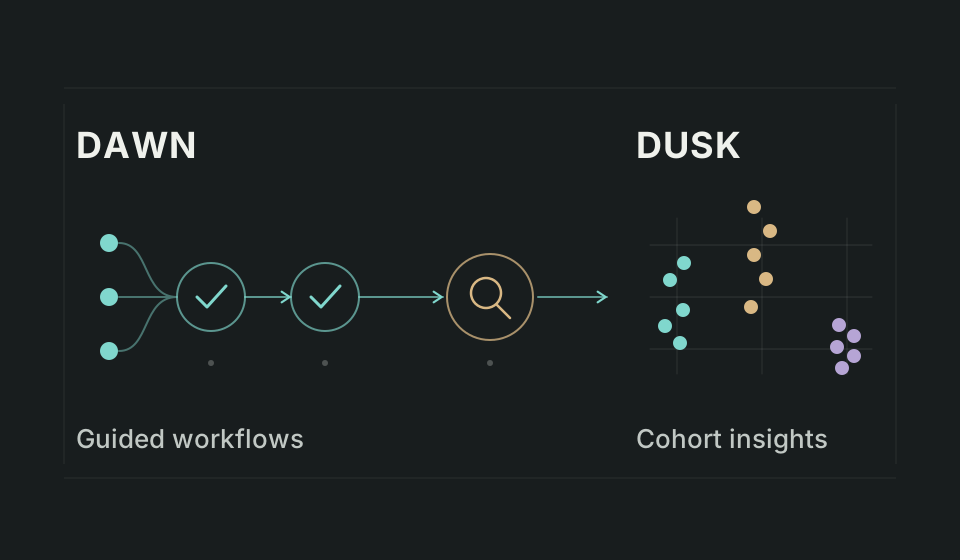
Conceptual workflow connecting DAWN guided analysis and visual validation with DUSK cohort-level insights.
Workflow overview · conceptual illustration

02 Scientific software

Good analysis should
be repeatable.

I built DAWN and DUSK codebases to make spatial analysis reproducible across datasets. Guided workflows preserve visual checkpoints with a human-in-the-loop interface; Python tools then support cohort-level statistics and publication-ready figures.

Watch the workflow webinar
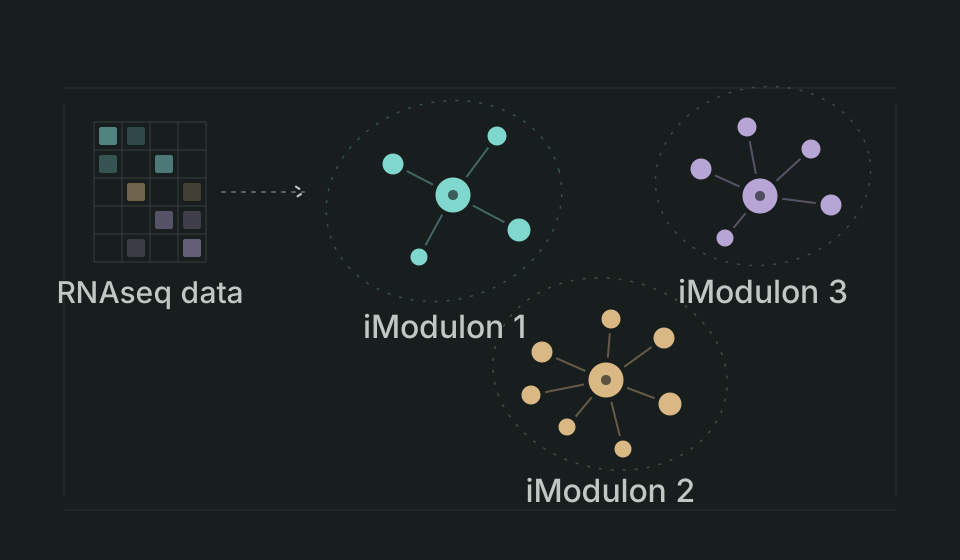
Conceptual illustration of genes organized into independently regulated transcriptional modules.
Transcriptional modules · conceptual illustration

03 Transcriptomics & systems biology

Finding structure in gene expression across microbial species.

During my PhD at UC San Diego, I developed iModulonDB 1.0, an interactive resource for exploring microbial gene regulation inferred from transcriptomic data. I also co-led the Genome Analytics group, connecting research, mentorship, and scientific software.

Explore iModulonDB

Selected publications

Every dataset has
a story.

Four first-author papers spanning transcriptional regulation, scientific resources, and laboratory evolution. 30+ peer-reviewed publications and 1,000+ citations.

All publications on Scholar
  1. 2025 · Genome Biology and Evolution

    Laboratory evolution reveals transcriptional mechanisms underlying thermal adaptation of Escherichia coli.

  2. 2023 · Cell Reports

    Laboratory evolution, transcriptomics, and modeling reveal mechanisms of paraquat tolerance.

  3. 2021 · Nucleic Acids Research

    iModulonDB: a knowledgebase of microbial transcriptional regulation derived from machine learning.

  4. 2020 · Nature Communications

    Machine learning uncovers independently regulated modules in the Bacillus subtilis transcriptome.

Get to know me

For me, curiosity
is personal.

I was originally inspired to become a bioengineer by my Mom, Lora. Her experience suffering from multiple sclerosis led to a dream to treat disease and improve lives.

I live in San Diego with my incredible husband, Sean. When I'm not diving into data, I love to travel around the world or unwind with a cocktail I've crafted. I also stay active with yoga, running, and weightlifting. I’m fascinated by astronomy and cosmology, and I’m continuing to develop my Spanish.

I’m drawn to collaborative research that connects biological measurements, rigorous analysis, and useful software.

Let’s connect

Good science starts
with a conversation.

kevinrychelpenn@gmail.com